Home Blog Page 14

5 Reasons You Shouldn’t Care About the New GMAT

0

Everyone has been talking for a while about the “New” GMAT. The Princeton Review advertises that they teach the best strategies to prepare you for the new section and Veritas Prep releases videos telling you you’re behind if you don’t know about it already. Even the makers of the GMAT have launched a new Official Guide to cover the revised section. THIS IS ALL HYPE!

Here are five reasons why you shouldn’t care about the new GMAT (note: some of these ideas are controversial!):

1. Only one section of the GMAT changed.

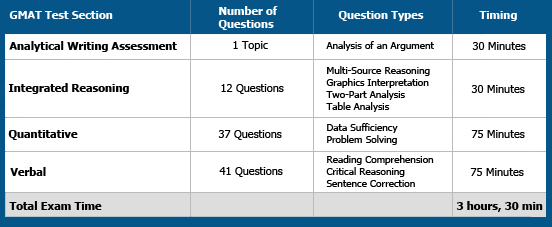
At the beginning of the old GMAT, there were two essays: Analysis of an Issue and Analysis of an Argument. The makers of the GMAT have dropped the issue essay (the argument essay is still there) and add an Integrated Reasoning section of 12 questions. That’s it! The quantitative and verbal sections of the test have not changed at all.

2. The score for the Integrated Reasoning section isn’t included in your 200 to 800 score.

This is absolutely the best reason not to worry about the New GMAT. The score you get on the essay and IR section don’t count in the score that MBA programs judge you by.

3. Your Integrated Reasoning score doesn’t appear on your unofficial score report.

If you’re like most students, you may take the test just before you apply to business schools and will, therefore, have to submit your unofficial score report (the report you get on the day of the test). Submitting an unofficial score report is perfectly acceptable for the majority of MBA programs. However, the IR score won’t be on this report, which means you will probably be accepted to your MBA program before they know your IR score.

4. There is no comparison for the Integrated Reasoning section score.

Since the section was just released, the makers of the GMAT and business schools don’t really know how to compare student scores yet. It will be at least two years before enough people take the test to yield any useful data so no one can really take the section seriously for now.

5. The Integrated Reasoning section tests skills you already have and can waste valuable study time.

The IR section includes tables, graphs, Venn diagrams, analytical questions, and basic mathematical calculations. You’ve probably developed many of these skills if you’re a working professional. Study for the rest of the GMAT (the quantitative and verbal sections that matter). Therefore, you will refine these skills and be well prepared for the New GMAT.

Don’t waste valuable study time mastering a section that doesn’t matter!


Need help preparing for the “New” GMAT?

Our American tutors have years of experience helping students just like you beat the GMAT. Check out our GMAT private tutoring and Whatsapp or email us at [email protected] to get started today!


The New GMAT Section Explained

0

All you business school hopefuls have heard by now that the GMAT has changed. Since we were updating our oh-so-useful GMAT Strategy Notes for our students, we decided to update our blog readers (and future students) as well. Here’s all you need to know about the new GMAT section.

What has changed on the GMAT?

The makers of the GMAT have dropped one of the essays (sadly, the easier one) and added an Integrated Reasoning section.

What hasn’t changed on the GMAT?

Every other section is still the same. NONE of the quantitative or verbal section has changed. There are no new question types or revisions to these sections. The Analysis of an Argument essay has not changed either.

So what’s the new test format?

2012 gmat format

What types of questions will I see?

There are four types of Integrated Reasoning questions:

  1. Table analysis: Determine whether each of the answer statements meets one of two conditions (e.g., true/false, yes/no, inferable/not inferable). This is easier than it sounds.
  2. Graphics interpretation: Use the graphs to answer fill-in-the-blank statements from pull-down menus. You may have to calculate percentages, percent change, probabilities, or averages.
  3. Multi-source reasoning: Use information from different sources (e.g., 3 emails, 2 scientific descriptions) to answer yes-no or multiple-choice questions. Science-based questions are favorites on these types.
  4. Two-part analysis: Use the information given to select two answers (one in each column). These questions are weird because the answer choices are offered in column format rather than row format, which is how most of us think.

You can practice with these question types on the GMAC Integrated Reasoning site.

Will I be able to use a calculator for the Integrated Reasoning section?

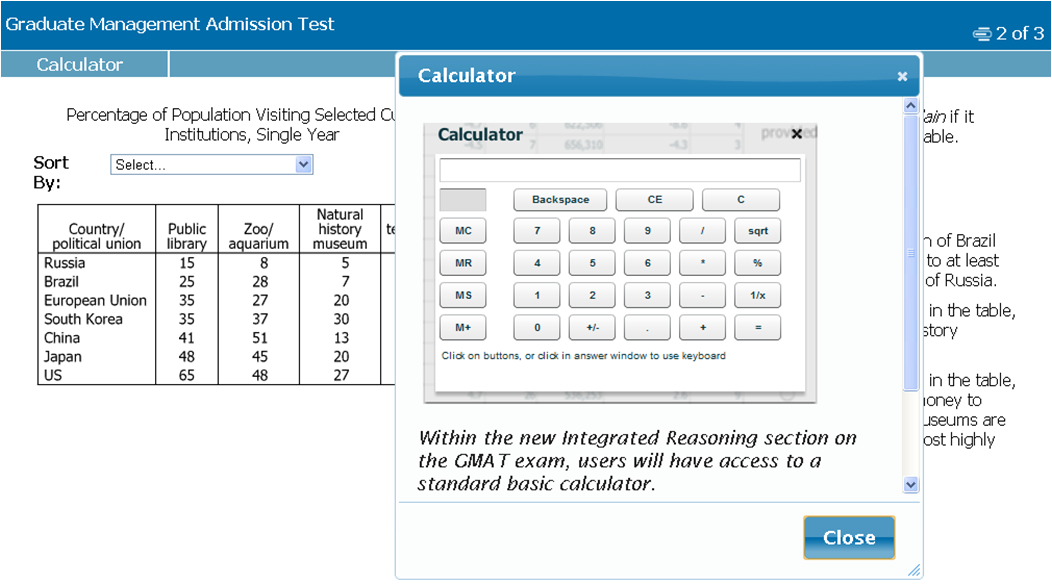
Yes, there is a basic calculator available ONLY for the IR section (You can’t use a calculator on the rest of the test). Click the ‘Calculator’ button on the left top corner and it will pop up as shown below:

2012 gmat calculator

Why was the GMAT changed?

The makers of the test felt the new GMAT section would be more relent to business school skills and provide useful information to business school. However, since the GMAT has almost nothing to do with business school other than the application process, we’ll assume they felt it was time for a test format change.

Are there any practice sections available?

You can practice the new Integrated Reasoning section on the GMAC Integrated Reasoning site. Don’t worry about buying a new Official Guide just to practice this section because nothing else about the test has changed.


Need help preparing for the “New” GMAT?

Our American tutors have years of experience helping students just like you beat the GMAT. Check out our GMAT private tutoring and Whatsapp us to get started today!


SAT Summer Reading List

Have some extra time during your summer break? Read a few of these books to effortlessly prepare for the SAT in your spare time. These books are the ideal SAT summer reading list. A warning, though, you may enjoy them.

SAT Summer Reading List

Things Fall Apart by Chinua Achebe
This book is so interesting and easy to read that I finished it in one sitting. Read about one man’s struggle in pre-colonial Africa for how one bad event can ruin everything.

Go Tell It on the Mountain by James Baldwin
The makers of the SAT are big fans of African-American literature. This Baldwin classic features real-life situations, bluesy characters, and a different side of American life.

The Canterbury Tales by Geoffrey Chaucer
Dig archaic English phasing and winding tales? Then you should enjoy Chaucer. Although a difficult read, this book is worth the effort for the dry British humor.

The Awakening by Kate Chopin
If you love tales of feminism and unexpected endings, check out Chopin.

The Great Gatsby by F. Scott Fitzgerald
Rich people spending a lot of money and doing foolish things. Remind you of anywhere?

Lord of the Flies by William Golding
What would you do if you and your schoolmates washed up on a deserted island? Find out how the book’s characters handled it.

The Metamorphosis by Franz Kafka
One word…weird.

Animal Farm by George Orwell
If you can understand the satire of this book, you will be able to handle just about anything the SAT can throw at you.

Walden by Henry David Thoreau
This book is one of my favorites. Thoreau presents an interesting point of view about life while being slightly anarchist.

Slaughterhouse-Five by Kurt Vonnegut, Jr.
Action-packed and slightly hard to follow, this book is incredibly vivid. I read it all weekend.

Want more books for your SAT summer reading list?

For a full list of books to put on your SAT summer reading list, check out the College Board List of 101 Great Books. Many of these books have been reproduced at low costs by Penguin Books. You can buy them at Borders in Mall of the Emirates and Ibn Battuta Mall or Kinokuniya in Dubai Mall for about Dhs 15 each. Look for the paperbacks with the peach-colored spine.


Need help preparing for the SAT during the summer?

Email APPLY ME at [email protected] or call us at 04 311 6830. We offer private tutoring with American tutors that will boost your score!


Why You Shouldn’t Take the June SAT

With the late registration deadline for the June SAT right around the corner, you’re probably deciding whether to take the test or wait until October. Here’s our advice: don’t take the June SAT.

Now, here are our reasons:

1. It’s finals time!

If your school is on a schedule similar to that of most schools in Dubai, your finals are rapidly approaching. You’ve got to study everything you’ve been doing since January (since September if you’re in a baccalaureate program) and you don’t have much time to do it. Do you really want to add SAT preparation and testing to that? While you will have other opportunities to take the SAT, you won’t have another chance to finish your sophomore, junior, or senior year well.

2. Most college deadlines have already passed.

If you’re a senior and you’ve waited until now to take the SAT, you’re in big trouble. Even if you can find a university that you can still apply to, you’ll be unlikely to be accepted and receive your student visa in time to start by orientation in August or September.

3. Standby slots are almost impossible to get in Dubai.

In order to take the SAT standby, you have to get the paper registration form from a school where the test is administered (this can’t be downloaded or found online) and show up early to the test center hoping they have extra seats. None of our students who wanted standby testing have EVER gotten it. Schools here rarely have paper registration forms (found in the registration booklet) and rarely know what you’re talking about.

Take our advice: wait for the October exam.


Need help preparing for the next SAT now that school is almost over?

Now is the best time to begin your preparation with our American native English speaking tutors. Private tutoring is simply the best! Whatsapp us find out how we can help you.


Applying to Business School? Start NOW!

Applying to business school? With the lazy days of summer approaching in Dubai, this is the perfect time for you to start your MBA applications so you don’t have to rush through the process. Here’s our advice:

1. Start thinking about the types of programs you’re interested in.

Do you want to stay in the UAE or go abroad? 1 year MBA or 2 year MBA? What would your specialization be? These are the questions you should know the answer to before you start applying. The more you can define the types of programs that interest you, the better you will be at selling your “fit” with the programs later.

2. Gather your supplemental documents.

Request your official transcripts (2 copies) and any previous test scores now. These documents are hard to obtain at the last minute and will be required no matter which schools you choose.

3. Decide whether to take the TOEFL.

Many programs will do not require the TOEFL for applicants educated in countries where English is the official language (unfortunately, the UAE and India do not count) or have attended undergraduate programs in which the primary language of instruction is English. If you don’t fit either of these categories but still feel like you should be exempt from taking the TOEFL, you should apply for a TOEFL waiver. Applying to business school typically does not require another test if you take the GMAT.

However, some programs, such as Columbia, require the TOEFL if you’re an international student (period, end of discussion). If you are required to take the TOEFL or think you may be, now is the time to get the test out of the way. It’s offered every Saturday at various locations around the UAE, so go to www.ets.org/toefl to register. Be sure to take the sample test provided free with your registration, so that you know the format of the test.

4. Prepare for the GMAT.

If you start applying to business school now, you’ll have the 2 to 3 months that you need to do well on the test. Think you need to score a 700? Think again. While higher scores are better, many European schools consider applicants quite competitive in the 600-650 range. Some schools only care that both your quantitative and verbal scores are above the 50th percentile.

Other schools, such as IE, INSEAD, and LBS, have started introducing their own admissions tests so that low scoring students with good profiles are still considered. Preparing for the GMAT is still the best way to prepare for these tests (it’s overkill…so you’ll be over-prepared). Choose a prep provider, set your study schedule, and register for the exam.


Need help preparing for the GMAT?

We offer a private preparation program that will help you get the best score you can. You’ll also get the benefit of our experience working with students accepted to programs all over the world. Whatsapp us for more info.


Ask APPLY ME: Are the Verbal Sections of the GMAT and SAT like the TOEFL?

Here’s a question we are asked frequently: Are the Verbal Sections of the GMAT and SAT like the TOEFL?

Our non-native English-speaking students often assume that the verbal section of the SAT or GMAT will be just like the TOEFL. However, the GMAT and SAT could not be more different from the TOEFL. The TOEFL is designed to test language ability and fluency while the GMAT and SAT test reading comprehension, critical reasoning (yes, there is an element of this on the SAT), and grammar.

So what does that mean?

It means that the SAT and GMAT are not really about how well you speak English but whether you can understand and reason through what you read. I recently had a Sudanese student for GMAT whose spoken English was difficult to understand. I thought that, maybe, he didn’t understand me either and was not getting much out of the class. When I looked at his answers to the practice questions, though, he had all of them right. While his spoken English was not good, his understanding of written English and the ability to answer questions was good.

Keep in mind that the GMAT and SAT are not really designed for non-native English speakers.

They are designed to confuse and frustrate American students (just kidding). If you want to increase your verbal score, you do not have to necessarily improve your English directly. You should focus on reading regularly and broadly. If you’re taking the SAT, read English language books that sound interesting. If you’re taking the GMAT, pick up Business Week or the Economist as well as a National Geographic Magazine (don’t forget about those natural sciences passages on the GMAT) from MacGrudy’s and read them from cover to cover. Read, understand, and improve your verbal score all at the same time.


Need help preparing for the GMAT or SAT?

Now is the best time to begin your preparation with our American native English speaking tutors. Private tutoring is simply the best! Whatsapp us to find out how we can help you.


5 Strategies Guaranteed to Increase Your Verbal Score

No matter what test you are preparing for or what guide you are using, if you do the things on this list, you are guaranteed to increase your verbal score. Some strategies are long term, while others should be implemented on test day. All of them work.

1. Read more.

People that read more read faster and understand more of what they read than the average person. Speed and accuracy are incredibly important on the verbal section of standardized tests, like the SAT and GMAT, and are the keys to scoring higher. Reading also improves your ability to recognize proper grammar, which is key for non-native English speakers.

2. Read widely.

The reading passages on the SAT, GMAT, GRE, and EA come from different books, magazines, stories, reviews…you get the point: passages can be pulled from anywhere. Just because you like reading Harry Potter books doesn’t mean you won’t get a passage from National Geographic magazine. The more diverse materials you read, the less likely you are to be clueless on the verbal section.

3. Make reading easy.

Too busy to go buy a book? You can read classic books FREE online or on your smartphone from Project Gutenbook. Don’t have time to read a whole book? Subscribe to email newsletters that come to your inbox. Check out the New York Times, Business Week, or the International Herald Tribune.

4. Use process of elimination to increase your verbal score.

This is the single best test-taking strategy for increasing your verbal score. Eliminate the answers you know are wrong and compare the remaining answers to figure out the right one. Even if you have to guess, your chances of selecting the correct answer improve significantly. You can learn more about process of elimination in one of my previous posts.

5. Look for the best of the worst in the answer choices.

Once you have eliminated two or three answer choices that you know are incorrect, it’s time to compare the remaining answers. Don’t put them back into the question. Instead, look at the differences between two (or three) choices. Which one is a better answer to the question? Maybe it’s not how you would have answered, but it’s the best of the bad choices.


Need help getting your verbal score together?

Whatsapp us to get help from our native English speakers! We can prepare you for the GMAT, GRE, EA, or SAT. Don’t wait until it’s too late to see significant improvement in your verbal score.


Five Ways to Improve Your Activity Resume’

More and more universities are asking students to submit a student or activity resume’.

Like a professional resume’, an activity resume lists your participation in organizations (e.g. Student Council) and any leadership positions you’ve held. Unlike a typical resume’, it doesn’t really list your work experience because it’s unlikely you’ve had any. This document is important, though, because it highlights how well-rounded you are (or aren’t). It also clearly lists your activities, so it’s easier for you to fill out applications.

5 Ways to Improve Your Activity Resume’

In case you’re struggling with the activity resume’, here are 5 ways to improve it.

1. Use the proper format.

It’s still a resume’, so it should be formatted like one. Check our post with sample resume’ formats that you can tailor. In general, you should have the following sections: education, achievements, key activities, other activities, skills, and hobbies.

2. Dig deep.

Think about everything you’ve been involved with over the last 3 or 4 years. In addition, ask your parents, siblings, and friends if they remember your activities. Be sure to think about any leadership positions, contests, or one-day events. Activities in the community or outside of school count, too. If you still don’t have much to write about, provide the details of any personal projects, such as blogs, you might be working on.

3. Get volunteering.

One of the easiest (and most honorable) ways to add more to your resume’ is to volunteer through one of Dubai’s charitable organizations. Check out a list from Time Out Dubai for ideas and contact information. If none of this interests you, get four friends and start your own project. See dosomething.org for how.

4. Add school stuff.

A student resume’ can borrow some characteristics from its older brother the profession resume’, and list interesting or advanced coursework in high school. Took AP or IB courses? Study business communication or management information systems? Great, add it all to your student resume’.

5. Edit your activity resume’.

Not carefully editing their resume’ may be the biggest mistake that all college, graduate school, and job applicants make. Go through each word of your resume’ carefully. Make sure the formatting is appealing but not flashy. Ensure all information is correct. Above all, be consistent. Your spacing may be too wide or your bullets weird, but the document should consistently make the same mistakes rather than being a mixture of incorrect and correct formatting, spelling, etc.


Need help with your activity resume’?

We build and edit student resumes as part of our comprehensive help. Email us at [email protected] about our comprehensive packages and get assistance with everything. You could be starting university in September instead of attending going away parties for your friends.


Ask APPLY ME: Should I apply to MBA programs in Round 3 or 4?

Here’s a question we are asked frequently: Should I apply to MBA programs in Round 3 or 4?

We’re 17 days into the New Year and Round 2 deadlines at many business schools have already passed. If you’re debating whether to apply in Round 3 or Round 4, we’ll make the decision easy for you: apply in Round 3.

Why You Should Apply in Round 3

Here’s our most compelling argument:

It can take up to 4 months to get your F-1 student visa.

If you apply to business school in April or later, even if you are accepted, your F-1 student visa may not be processed by August, when orientation starts. We have had previous students who had to wait a year after being accepted to prestigious schools because their visas weren’t approved by August. In fact, many b-schools have an early cut off for international students to ensure accepted students get their visas in time.

Later rounds are more competitive than earlier rounds.

Classes fill as the rounds proceed, so often by the third round, much of the class will be full. Imagine how competitive that makes Round 4. Moreover, waitlisted applicants from Round 1 are often admitted or declined with or after the second round, further reducing the number of seats available.

In our opinion, the early bird gets the worm. If you can’t apply in Round 3, think about applying for the next year (Round 1, of course) and make sure that business school is really something you want to do.

Not sure whether you are ready to apply for Round 3?

Here’s a quick checklist of things you should have already done if you are ready to apply for Round 3:

  • Completed your GMAT preparation.
  • Taken the GMAT at least once.
  • Started the application form.
  • Reworked your CV/resume’.
  • Requested your transcript.
  • Had your transcripts translated if they are not in English.
  • Started your MBA essays.
  • Requested your recommendations.

If you have already done all this, then you are in good shape to finish the application by the Round 3 deadline. If not, wait until Round 1 of the next cycle.


Need help applying to MBA programs?

We offer start to finish essay editing services for competitive prices. Check out our page on essay editing or email us for more information.


It’s NOT too late to apply!

0

With the end of fall term and the holidays approaching, many students assume it’s too late to apply to universities in the US, UK, Canada, and Europe. If your friends have already sent off their applications, they may be telling you that it’s too late to apply and you will have to wait one year before you can start university.

We are here to tell you it’s NOT too late to apply. Although east coast deadlines have passed for unis, such as NYU and Harvard, there are many, many universities that have February, March, and April deadlines. Check out some of the upcoming application deadlines for popular universities below:

Selected US University Deadlines

Drexel University (Feb. 1st)
Florida Institute of Technology (Jul. 10th)
Illinois Institute of Technology (Jun. 11th)
Loyola University (Feb. 15th)
New York Institute of Technology (Mar. 1st)
Pace University (Feb. 15th)
The American University of Paris (Jul. 11th)
University of Massachusetts Boston (Apr. 1st)
University of Michigan (Feb. 1st)

Selected Canada University Deadlines

McGill University (Jan.15th, but the document deadline is Mar. 15th)
Concordia University (Feb. 1st)
University of British Columbia (Jan. 31st)
University of Toronto (Feb. 1st or Mar. 1st, depending on your major)
York University (Feb. 1st, Feb. 8th, or Jun. 1st, depending on your major)


It’s not too late to apply if you get help!

These are only a few of the universities with deadlines in the new year. If you haven’t started yet it’s not too late. Whatsapp us, so we can help you decide where to go and help you throughout the application process.

As part of our Comprehensive Packages, you’ll get help from an American admissions consultant throughout the entire process. Don’t get left in Dubai while your friends go abroad for university!